
Negotiating is first and foremost a strategic activity. To get something, it is not enough to want it; you have to put in place a favourable process.
Negotiation is a dynamic and interactional game. Our requests will be fulfilled according to the reactions of the opposing party. Therefore, the result of the negotiation is not the result of any law, but is a point of balance. While the law provides the framework for legitimate expectations and expectations, the outcome of the negotiation will depend on the attitudes, strategies and demands of the parties.
The concept of Balance point is essential. Good financial negotiation can have significant future human consequences. Thus, a spouse who is adamant about the amount of the compensatory benefit may see his relationship with his children affected. So there is an overall thought to keep in mind.
Several elements and concepts from game theory and behavioral economics make it possible to properly frame a negotiation.
What I really want & what she/he wants — The marginal zone of acceptance
La marginal zone of acceptance is the subjective space in which agreement can take shape. It is situated at the crossroads of two questions: What do I want? What does he/she want?
Knowing what we want allows us to determine the limits of our acceptance.
In technical jargon, the two utility curves meet in the marginal zone of acceptance.
The chart below illustrates these concepts. It has only a schematic purpose. In reality, an individual's needs and demands never align wisely on a single curve.
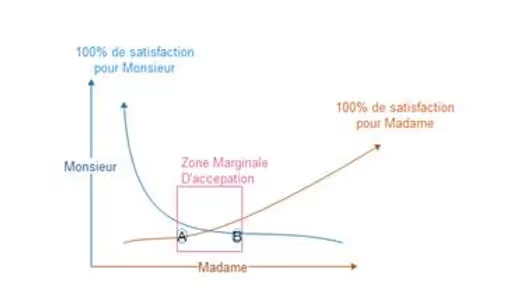
Figure 1 - Utility curve graph
In theory, the meeting point is the Sweet Point. However, it is not because we are at the meeting point that we have an agreement: any agreement is subjective, the meeting point is only transformed into an agreement if and only if, the two parties see this point as actually the meeting point. In reality, the encounter takes place somewhere in the marginal zone of acceptance.
This type of utilitarian schema is the subject of very advanced modeling in the context of litigation or major contractual arbitration to help decision-making.
Decision vectors — Indirect influence
Influence is an oblique art. You influence from the side. A marketing expert to sell a perfume will not say that it smells good. It will show a beautiful and free woman and a rebellious man driving in the desert at night. It is an indirect influence by identification.
In divorce negotiations, the most important thing is to influence the decision vectors (see Divorce and negotiation 1). How will the opposing party make its decision and on what criteria? Influencing these criteria makes it possible to move the Marginal Acceptance Zone and to define its contours.
Monsieur knows that Madame wants to buy a new property after the divorce. It is possible to focus the discussion on the amount of the compensatory benefit towards the terms of purchase of this property. The Marginal Acceptance Zone begins with the financial position that will allow Madame, at the maximum of her borrowing capacity, to buy a property that is just acceptable. It will end up at the maximum amount that Mr. can agree without ending up in an unsustainable financial situation.
Therefore, it is necessary to analyze which decision parameters play to our advantage and to suggest them skilfully.
Influencing on decision vectors allows To move the lines of marginal zone of acceptance in our favor to determine the Worst Possible Option.
Subjective Decision Parameters — The Worst Possible Option
The Worst Possible Option is the point that is at the edge of the marginal zone of acceptance of the opposite party, that is, of the worst acceptable solution for the other party. This is the offer just good enough for the opposite party to say: OK.
In our diagram, the worst possible option for Madame is at point A and for Monsieur at point B.
How you noticed it: we analyze in the negative. What is the worst option for the other and not the best option for me. In strategy, you always have to start from the other person's point of view and not from your own.
What I say first! L'Anchorage
The anchor point is well known to negotiators. Making a proposal first helps to anchor the debate. Any subsequent proposal will be made according to this anchor point. Therefore, this anchor point should be made as soon as possible.
Where to anchor? To the worst possible option! For sir, we anchor at point A, for madam, at point B.
Not above, not below. Right where the worst possible option is in the opposite game. If you ask for too much, then your anchor is too far from the shore and is not taking hold. It should be anchored at a point on the outer limits of the marginal zone of acceptance.
Determining the Worst Possible Option must be done accurately. It is first necessary to determine the decision vectors and to verify them. Then, research should be done to quantify the requests. This is the most important work in preparing for divorce negotiations.
The power of uncompromising — credit and transactions
Once the Anchor is placed at the Worst Possible Option level, it is important to stand firm. The adversary will want to improve his position but will do so not from the center, but from his marginal zone. The negotiation will require more energy and will be less likely to reach an agreement that is biased in his favor.
Any concession must be: slow, painful and painful (see Divorce and Negotiation 3). You should build credit around your position by moving only as slowly as possible as if it were a sticky and viscous substance that you can't get rid of.